
There’s a quiet moment that still sits with me.
I was in my early twenties, sitting in a crowded café with a friend who had just come out as trans. I remember feeling proud of myself for “being supportive.” I listened, I nodded, I said all the right things. But then I asked a question that, in hindsight, made my allyship about me:
“So… what should I be doing to be a good ally?”
They paused, looked down at their coffee, and said gently, “Honestly? I’m really tired of explaining that. I just need you to listen, to believe me, and to pay attention.”
I remember feeling embarrassed, even a little defensive. I thought I was doing the right thing by asking. But what they were saying—what I only really understood later—was that being an ally isn’t about asking marginalized people to hand us a checklist. It’s about doing the work ourselves, consistently, imperfectly, and often quietly.
That moment became a turning point for me in understanding what allyship and solidarity actually look like in practice.
—
From “Nice Person” to Active Ally
Many of us like to think of ourselves as “good people.” We’re against racism, sexism, homophobia, transphobia, ableism, and all the other systems of oppression that shape our world. We repost the right things. We vote the right way. We try not to hurt anyone.
But there’s a difference between being a generally kind person and being an active ally.
Allyship isn’t about our self-image; it’s about our impact.
It asks questions like:
– When someone is being talked over, do I intervene or stay quiet?
– When I benefit from a system that harms others, do I notice? Do I act?
– When I’m called out or corrected, do I get defensive or curious?
I’ve had to confront the gap between who I thought I was and how I actually showed up.
For example: I once sat in a meeting where a colleague of color suggested a change to a project. Their idea was brushed aside, and a few minutes later, a white colleague made a similar suggestion and was praised for it. I noticed. I felt uncomfortable. And I said nothing.
Later, I told myself a familiar story: “It all happened so fast. I didn’t know what to say. I didn’t want to make it awkward.”
But that’s the thing: allyship is often awkward. It disrupts the flow. It risks social friction. It asks us to be uncomfortable for the sake of someone else’s dignity and safety.
That day, my silence protected my comfort and maintained the status quo. It did nothing for the person whose contribution was dismissed.
—
Privilege as a Responsibility, Not a Verdict
Privilege is a word that can make people tense up. It can feel accusatory, as if it’s saying, “You don’t deserve what you have.” But privilege isn’t a moral verdict; it’s a description of how systems treat us.
You might have privilege because of your race, your gender, your citizenship, your class, your able-bodiedness, your neurotype, your sexuality, or any number of intersecting factors. Having privilege doesn’t mean your life is easy; it means your identity isn’t making it harder in specific, systemic ways.
The question isn’t, “Do I have privilege?” The question is, “What will I do with the privilege I have?”
Some reflection questions:
– In what spaces do I feel safest, most “normal,” most unquestioned? That’s often where I have privilege.
– Where do I assume I’ll be treated fairly without having to prove anything? That’s often where I have privilege.
– Where do I get to be “an individual,” while others are seen as representing their entire group? That’s often where I have privilege.
Once we see our privilege, we can treat it as a responsibility:
– To speak up when others can’t.
– To make room when we’re used to being centered.
– To share resources and opportunities we access more easily.
– To challenge policies and practices that benefit us at others’ expense.
Privilege isn’t something to hide or deny; it’s something to leverage for collective good.
—
Intersectionality: Holding More Than One Truth at a Time
Intersectionality, a term coined by legal scholar Kimberlé Crenshaw, helps us understand how different forms of oppression overlap and compound. It reminds us that people aren’t just “one thing”: not just Black, or disabled, or queer, or immigrant—but often many of these at once.
A Black woman’s experience of sexism isn’t the same as a white woman’s. A disabled trans person’s experience of discrimination isn’t the same as a cis disabled person’s. Intersectionality asks us to resist flattening people’s lives into single categories.
I remember a conversation with a friend who is both queer and disabled. We were talking about Pride events, and I said something like, “It must be so affirming to be in such a big, loud, joyful crowd.” They smiled and said, “Sometimes. But a lot of pride spaces aren’t accessible. So I’m included in theory, but not in practice.”
That stuck with me. Here I was, celebrating how inclusive something felt, without noticing who still wasn’t being included.
Intersectionality invites us to ask:
– Who is missing from this space?
– Who is here but not fully heard?
– Whose needs are treated as optional?
It pushes us beyond symbolic inclusion toward structural change.
—
Listening Without Making It About Us
One of the most challenging parts of allyship is learning to listen without centering ourselves.
When someone shares their experience of harm, it’s tempting to respond with:
– “I’m sure they didn’t mean it.”
– “Are you sure you’re not overreacting?”
– “That’s terrible, but I’ve also experienced…”
These responses shift the focus away from the person who’s been harmed and back onto our own comfort, our own interpretations, our own stories.
A different approach might sound like:
– “I believe you.”
– “Thank you for trusting me with this.”
– “What do you need right now?”
– “Would you like me to say something or support you in taking action?”
I’ve learned the hard way that being an ally doesn’t mean always having the right words or solutions. It often means being willing to sit with someone’s pain without rushing to fix it or explain it away.
—
Making Allyship a Practice, Not an Identity
One trap I’ve fallen into—and still have to watch for—is treating “ally” as a stable identity: something I am, rather than something I do.
When allyship becomes part of our identity, criticism can feel like an attack on who we are. We might think:
– “But I’m one of the good ones.”
– “I didn’t mean it like that.”
– “You know I’m on your side.”
The reality is that we can:
– Vote progressively and still reinforce stereotypes.
– Have diverse friends and still benefit from racism.
– Support trans rights and still misgender someone.
Allyship is not about perfection; it’s about accountability.
Some questions I return to:
– When was the last time I changed my mind about something important because I listened to someone more impacted than me?
– When was the last time I apologized without centering my intent?
– When was the last time I took action that cost me something—time, comfort, status, money—for the sake of someone else’s liberation?
If those answers are “I don’t remember,” that’s a signal to re-engage.
—
Small, Concrete Ways to Practice Solidarity
Building a more just world can feel overwhelming. The problems we face—climate crisis, racial injustice, economic inequality, attacks on trans and queer people, erosion of democratic norms—are massive. No single person can fix them.
But we’re not asked to fix everything alone. We’re asked to do our part, where we are, with what we have.
Some practical starting points:
1. Educate yourself proactively.
Read books, essays, and articles by people from marginalized communities. Follow organizers and activists. Learn the history of the issues you care about.
2. Audit your spaces.
Look at your workplace, your group chats, your communities:
– Who is missing?
– Who is present but silent?
– What barriers—physical, cultural, financial—might be in the way?
3. Redistribute resources.
Support mutual aid funds, grassroots organizations, and local initiatives. If you have more than you need, consider how you can share.
4. Practice speaking up.
When you hear a harmful joke, a dismissive comment, or a policy that disadvantages certain groups, practice intervening. It might be as simple as, “That doesn’t sit right with me,” or “Can we rethink this?”
5. Build relationships, not just positions.
Solidarity is built through trust. Show up consistently, not just when there’s a crisis or a trending hashtag.
—
A Path Forward: Gentle With Ourselves, Fierce for Each Other
If you’ve recognized yourself in any of these stories—as someone who stayed quiet, who centered their own feelings, who missed who was being excluded—you’re not alone. I’m still unlearning, still messing up, still being called in.
The point is not to arrive at some final, enlightened state. The point is to stay in the work.
Maybe these questions can accompany you:
– Where do I feel most tempted to look away?
– Whose voices am I still not hearing?
– What would it mean to see my freedom as bound up with theirs?
We are living in a time of profound uncertainty and profound possibility. Old systems are cracking; new ways of being are emerging. In this moment, allyship and solidarity are not optional virtues—they are survival tools, and they are building blocks for a world in which more of us can breathe, rest, and belong.
We won’t get it right all the time. But we can keep showing up, listening deeply, acting with courage, and choosing, again and again, to align ourselves with justice over comfort.
That, to me, is the heart of progressive growth: not perfection, but a persistent, humble commitment to building a world where fewer people are sacrificed for someone else’s convenience—and where all of us, in our full, intersecting selves, have room to live and to thrive.
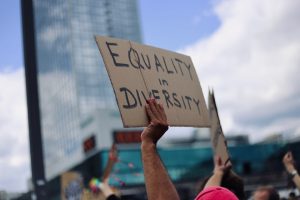
Photo by Dima Kapralov on Unsplash
Relacionado
Discover more from Fyra - Dating App for Progressives
Subscribe to get the latest posts sent to your email.