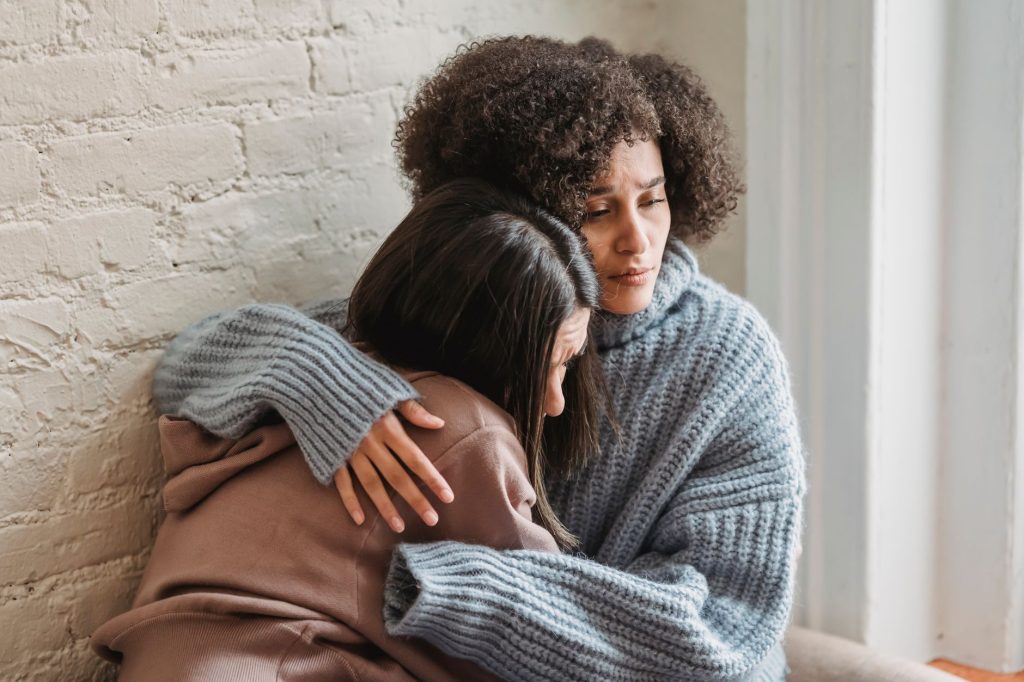
Women are strengthening their bonds, and sisterhood marks the new wave of feminism. Care, which once fell solely on their shoulders, is now being seen as a collective responsibility — with routines interrupted by moments of rest for the body and mind.
This shift isn’t just a nice line for social media. It responds to a real, measurable, and urgent problem: women’s bodies and minds are exhausted.
The numbers behind the exhaustion
Recent data from the U.S. Census Bureau shows that full-time working women still earn about 81 to 83 cents for every dollar earned by men — a gap that widens sharply once children enter the picture. Mothers working full time earned roughly 35% less than fathers in 2024, according to a Bankrate analysis of Census data, a wider gap than in the two previous years. Research from the Institute for Women’s Policy Research shows the “motherhood penalty” accounts for nearly 80% of the overall gender pay gap, with each child under five projected to reduce a mother’s earnings by about 15%.
This inequality doesn’t stand alone — it travels hand in hand with another alarming number. Multiple 2025–2026 workforce studies point in the same direction: Gallup found women in leadership report burnout at notably higher rates than men, and separate surveys from Deloitte and Mind Share Partners show women across the workforce are consistently more likely than men to report feeling burned out, struggling, or in crisis.
Behind these statistics is a concept that has gained real traction in public conversation: the mental load, the invisible work of planning, remembering, and anticipating everything that needs to happen — from the grocery list to a child’s pediatrician appointment to a work deadline. It isn’t just doing; it’s remembering, foreseeing, and carrying the responsibility for all of it, quietly, all the time.
Add to that the “second shift” at home and the well-documented penalty women face for taking time off after having children, and the picture becomes clear: women’s exhaustion isn’t a matter of individual fragility. It’s structural.
Sisterhood: from slogan to real support network
It’s in this context that sisterhood — or solidarity, as it’s often framed in American feminist writing — stopped being just a theoretical concept and became everyday practice. Feminist scholar bell hooks, one of the most influential voices on the subject in the United States, argued that women’s solidarity requires a shared commitment to ending sexist oppression — not simply shared identity, but active political alliance grounded in mutual respect and care.
In practice, this translates into concrete gestures: mentorship between women at work, support networks for single mothers, peer groups for talking openly about mental health, mutual protection in situations of harassment or disrespect, and the simple — but powerful — refusal to compete where rivalry was once expected.
Research in social psychology reinforces that these support networks have a direct effect on psychological well-being: belonging to collective spaces strengthens a sense of connection and self-efficacy, and mutual support helps buffer the stress and anxiety caused by gender-based discrimination. Sisterhood, in this sense, isn’t sentimentality — it’s public health.
Self-care: from the margins of feminism to the center of the conversation
If sisterhood tends to the “we,” self-care tends to the “I” — and the two move together. For a long time, caring for oneself was treated as a luxury or an indulgence. Writer and activist Audre Lorde reframed that idea decades ago with a line that still anchors the conversation today: caring for herself, she wrote, was not self-indulgence — it was self-preservation, and that was an act of political warfare.
In practice, that means routines with real pauses: therapy, sleep, moments of quiet, exercise without guilt, saying “no” without writing a paragraph-long justification. It also means recognizing that setting boundaries isn’t selfish — even though, as recent research shows, women who set limits are still often judged as “cold” or “difficult,” a bias men rarely face for the same behavior.
The turning point in contemporary feminism is understanding exactly this: self-care can’t be one more solitary task added to an already long list. It only holds up when there’s a network — of friends, colleagues, family — that supports that time to rest, instead of demanding uninterrupted output.
What this changes in practice
Companies, collectives, and feminist organizations are already building this logic into how they operate: structured mentorship programs for women, workplace mental health support groups, and a growing understanding that tackling women’s burnout requires leadership that integrates performance with emotional support — not the other way around.
But maybe the most significant shift is cultural: the idea that a woman caring for herself and caring for other women aren’t separate gestures — they’re part of the same movement. Rivalry, competition, and isolation were — and to some extent still are — tools that kept women facing collective problems alone. Sisterhood breaks that cycle by turning care into a network, instead of an individual burden.
Conclusion
Talking about sisterhood, self-care, and mental health in 2026 means talking about politics, economics, and survival — not just wellness. The numbers on women’s burnout and the persistent gender pay gap make clear that women’s exhaustion has structural roots, which is exactly why the response has to be collective too. Resting, asking for help, and caring for other women have stopped being isolated gestures and become, together, a concrete form of resistance.
Sources
- Pew Research Center. Gender pay gap remained stable over past 20 years in US (2025). pewresearch.org
- National Women’s Law Center. A Window Into the Wage Gap (2025–2026). nwlc.org
- Bankrate. The motherhood penalty: Mothers earned 35 percent less than fathers in 2024. bankrate.com
- Institute for Women’s Policy Research. Motherhood Is Hard—Pay Penalties Make It Harder. iwpr.org
- Gallup. Women Show Stronger Employee Engagement Amid Higher Burnout (2026). gallup.com
- Wellhub (HR research). Burnout in U.S. Working Women: What HR Needs to Know. wellhub.com
- CNBC / SurveyMonkey. Women at Work 2025–2026. surveymonkey.com
- bell hooks. Feminism Is for Everybody: Passionate Politics. South End Press.
- Audre Lorde. A Burst of Light: Essays. Firebrand Books.
Additional workforce and mental health figures also draw on reporting from the American Psychological Association’s Work in America Survey and Deloitte’s Women @ Work research, cited in the sources above.
Don’t forget to follow Fyra on social media!