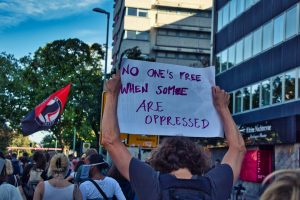

I used to think of myself as “one of the good ones.”
I voted the right way, read the right books, shared the right posts. I knew the language of social justice well enough to move through progressive spaces without raising eyebrows. But a few years ago, a friend said something that quietly rearranged my understanding of myself.
We were leaving a community meeting about housing justice. I’d been particularly vocal that night—offering suggestions, challenging the city’s policies, emphasizing how “we” needed to do better.
On the walk home, my friend said, gently:
“You’re really good at talking about systems. But sometimes it feels like you forget you’re part of them.”
It landed like a stone in my chest. I realized I had been positioning myself as somehow outside of the structures we were critiquing—as if I were the exception, the enlightened one observing injustice rather than someone shaped by, and benefiting from, those same systems.
That conversation was the beginning of a shift: from seeing myself as “a good ally” to understanding myself as a work in progress—someone learning, unlearning, and messing up in public, in relationship, and in real time.
This is a reflection on that shift, and on what it might mean to move from performative allyship toward a more grounded, imperfect, but honest solidarity.
—
The Myth of the Finished Self
One of the most seductive ideas in progressive spaces is that we can arrive at a kind of moral completion.
We don’t say it out loud, but it shows up in subtle ways:
– The pressure to have the right take on every issue.
– The fear of being called out, which can morph into defensiveness.
– The quiet satisfaction when we’re seen as “woke,” “aware,” or “on the right side of history.”
But if we’re honest, most of us are navigating overlapping identities—some marginalized, some privileged, some shifting depending on context. There is no stable “good person” identity to achieve. There’s just the ongoing work of noticing: Where do I have power? Where do I have blind spots? Where am I still centering myself?
I remember a moment in a workplace training on racial equity. I’d spoken up about a pattern I’d noticed, feeling quite proud of myself for naming it. Afterward, a colleague pulled me aside and said, “I appreciate what you said—but you talked over two people who were trying to say the same thing.”
I wanted to disappear. My instinct was to explain, to justify: “I was just trying to help,” “I didn’t see them unmuting,” “I thought silence meant no one else wanted to speak.” But the harder truth was that my sense of urgency and my comfort with speaking had once again overridden my ability to notice who wasn’t being heard.
The lesson wasn’t that I should never speak again. It was that “being on the right side” of an issue doesn’t exempt me from replicating the very dynamics I say I’m against.
We are never finished. And that’s not a failure; it’s the work.
—
Intersectionality Isn’t an Identity Badge
Intersectionality started as a legal and theoretical framework, articulated by Kimberlé Crenshaw, to describe how Black women were being erased in both feminist and anti-racist discourse. It has since become a buzzword, often flattened into a kind of progressive branding.
But intersectionality isn’t a badge we wear to show how nuanced we are. It’s a lens that asks:
Who is missing from this conversation?
Whose experience doesn’t fit our neat categories?
Where do different forms of oppression overlap—and where do we overlook them?
I’ve seen this in myself when I focus on one axis of identity and forget others. For example:
– Advocating for LGBTQ+ rights while assuming everyone shares my middle-class flexibility around “coming out” safely.
– Talking about disability access as if it’s purely a physical issue, ignoring how race, income, and immigration status shape who gets labeled “disabled” and who gets support.
– Centering gender equity in a way that assumes a Western, binary understanding of gender.
Intersectionality invites us to move beyond “add diversity and stir.” It asks us to redesign our questions, not just expand our lists.
A practical way I’ve tried to apply this: when I’m part of planning something—a meeting, an event, a policy—I pause and ask:
– Who is this built for?
– Who might be unintentionally excluded?
– Who is only being thought about in the abstract, not invited into the room?
I don’t always have the answer. But even the act of asking shifts the conversation.
—
The Subtle Comfort of Performative Allyship
Performative allyship gets talked about a lot: the social media posts, the yard signs, the slogans. But the most insidious performances are often invisible to others and only obvious if we’re willing to be brutally honest with ourselves.
Some questions I’ve had to sit with:
– Am I showing up because I truly care—or because I don’t want to feel guilty?
– When I share a story of harm, whose experience am I centering—mine, or the person harmed?
– Do I only speak up when there’s social approval or applause?
– Am I more invested in being seen as “good” than in actually changing my behavior?
There was a moment, not long ago, when I realized I’d been using activism as a way to manage my own anxiety. I’d sign petitions, attend webinars, and donate small amounts to many causes—partly out of genuine care, but partly to soothe the feeling of helplessness.
None of those actions were inherently wrong. But I had to ask: Is my primary goal to alleviate my discomfort or to contribute to collective change? The answer reshaped how I chose to engage.
—
From Allyship to Solidarity
“Ally” can sometimes feel like a title—something you are or aren’t. “Solidarity” feels more like a practice.
Allyship can lean toward:
– Helping “them”
– Speaking for others
– Stepping in as a protector or rescuer
– Centering individual morality
Solidarity leans toward:
– Seeing your liberation as intertwined with others’
– Being accountable to the communities most impacted
– Sharing risk, not just offering support from a safe distance
– Working to change structures, not just individual behaviors
Solidarity means asking different questions:
– Who am I accountable to?
– How do I know what support is actually needed?
– Where am I willing to be uncomfortable, to risk reputation, convenience, or relationships?
– How do I stay when things get messy, when I’m called in or called out?
I remember being in a community group where a decision was made that I strongly disagreed with. My first impulse was to leave, to find a space that “aligned better with my values.” But a mentor challenged me: “What if solidarity means staying in the room and doing the slow work of building trust and changing culture?”
Staying didn’t feel heroic. It felt tedious, humbling, sometimes infuriating. But it also taught me that transformation is rarely dramatic. It’s often incremental, relational, and deeply unglamorous.
—
Questions for Self-Reflection
If you want to explore your own relationship to allyship and solidarity, you might sit with questions like:
1. Where do I hold unearned advantages (race, class, citizenship, ability, gender, etc.)? How do those shape my daily life in ways I rarely notice?
2. When was the last time I changed my mind about a deeply held belief? What helped me shift?
3. How do I respond when someone tells me I’ve caused harm? Do I get defensive, disappear, or lean in and listen?
4. Where am I more invested in being perceived as “good” than in being honest about my impact?
5. What communities or movements am I accountable to? How do they experience my presence?
6. Where do I feel discomfort when issues of justice arise—and what might that discomfort be pointing to?
You don’t have to answer all of these at once. Even choosing one and journaling about it can open something.
—
Paths Forward: Small, Real Steps
A better world won’t be built by perfect people. It will be built by flawed, contradictory humans who keep choosing to show up, to listen, to repair, and to begin again.
Some practical paths forward:
– Practice listening more than speaking. In spaces where you hold privilege, experiment with speaking later, asking more questions, and noticing who hasn’t been heard.
– Build long-term relationships. Instead of hopping from cause to cause, choose one or two communities or issues to commit to over time. Let people get to know you. Let yourself be known.
– Learn privately, not just publicly. Read, watch, and listen without needing to broadcast every insight. Let your understanding deepen in ways that don’t rely on external validation.
– Normalize repair. You will mess up. Plan for it. Learn how to apologize without centering your own shame. Ask what repair looks like and follow through, even if it’s inconvenient.
– Notice where you check out. When a headline feels overwhelming or a conversation gets tense, pay attention to your urge to disengage. What would it look like to stay just a little longer?
—
I no longer aim to be “one of the good ones.” That phrase has started to feel like a trap—an invitation to stagnation, to self-congratulation, to distance.
Instead, I’m trying to be someone in motion: learning, unlearning, listening, fumbling, trying again. Someone willing to see myself as both shaped by injustice and capable of resisting it. Someone who understands that solidarity isn’t a posture I strike—it’s a practice I return to, imperfectly, over a lifetime.
If you’re reading this, you’re likely already someone who cares, someone who wants to contribute to a more just and livable world. The question isn’t whether you’re “good enough” to do that work.
The question is:
Are you willing to be honest enough, humble enough, and persistent enough to keep going—even when the story you tell about yourself has to change?
Because that, more than any slogan or statement, is where a better world begins.
Relacionado
Discover more from Fyra - Dating App for Progressives
Subscribe to get the latest posts sent to your email.