When Liberals Echo the Far Right: What Ceuta’s Border Crisis Reveals About Europe’s Immigration Debate
——————————————————————-
In the scramble to respond to rising far-right nationalism, many liberal institutions say they’re defending democracy and human rights. But at Europe’s southern edge—in the Spanish enclave of Ceuta on the Moroccan coast—something troubling is happening. As The Intercept reports in “Liberals Are Ceding Ground to the Far Right on Ceuta Border Crossings,” even mainstream outlets and EU officials who claim to counter xenophobia are increasingly accepting the right’s core anti-immigrant assumptions.
This matters far beyond Spain’s borders. Ceuta is a test case for how Europe will treat refugees and migrants in an era of climate crisis, war, and economic inequality—and whether liberal politicians and media will defend human dignity or quietly normalize fortress-style exclusion.
1. Ceuta, Migration, and the Politics of Fear: The Basics
Ceuta is a small Spanish city on the North African coast, one of two Spanish enclaves (along with Melilla) bordering Morocco. These territories are not just geographic anomalies; they are physical manifestations of Europe’s external border, complete with high fences, surveillance systems, and heavily policed crossing points.
Over the past several years, Ceuta has periodically hit global headlines when large numbers of people—mostly from sub-Saharan Africa, but also from Morocco and other regions—attempt to cross into the enclave. Some swim around breakwaters; others try to scale border fences or enter through official checkpoints. Many are fleeing poverty, political instability, or violence. Some are seeking asylum. Others hope to move onward into mainland Spain and the wider EU.
Each spike in crossings tends to trigger a familiar cycle:
– Far-right parties and pundits frame the situation as an “invasion” or “assault” on Europe.
– They demand harsher border controls, militarized responses, and mass expulsions.
– Liberal politicians and institutions respond by insisting that the situation is “under control” and that Spain and the EU are managing the border “responsibly and humanely.”
But as The Intercept piece shows, those liberal defenses increasingly accept the far right’s basic framing: that migrants at Ceuta are a threat, that their presence must be minimized, and that the primary goal is protecting Europe’s borders rather than people’s lives.
2. How Liberals Are Repeating Far-Right Premises
The article highlights a pattern in mainstream media coverage and official EU statements: instead of challenging anti-immigrant narratives, liberal voices often validate them in subtler language.
A few recurring themes:
1. Security-first framing.
Coverage emphasizes “border security,” “stability,” and “order,” often portraying crossings as a crisis to be contained rather than a humanitarian situation to be addressed. Even when rejecting overtly racist rhetoric, liberal actors still treat migration as a security problem.
2. Numbers as threat.
Far-right figures use large numbers to stoke fear—“thousands entering at once,” “waves,” “floods.” Liberal commentators may dismiss the most extreme alarmism but still describe migrants in terms of “surges” and “pressure,” reinforcing the idea that more people automatically equals danger.
3. Legitimizing deterrence.
The EU and Spanish government frequently stress measures to “discourage irregular crossings,” such as increased patrols, tighter cooperation with Moroccan security forces, and faster deportations. These policies are presented as pragmatic, necessary, and even compassionate—as if keeping people out is in their best interest.
4. Silence about root causes.
The focus remains on managing the border rather than addressing why people are moving: colonial legacies, trade policies that undercut African economies, climate impacts, wars in which Western countries are often implicated. By ignoring these factors, liberals inadvertently support the narrative that migration is an irrational or opportunistic choice.
The result is a political space where the far right sets the terms of debate, and liberals play defense within those terms. Instead of questioning whether borders should be enforced with lethal force or whether deterrence is compatible with human rights, they argue that their enforcement is more “responsible” than the right’s.
3. A Progressive Analysis: What’s Really at Stake in Ceuta
From a progressive perspective, Ceuta is not just a border management challenge; it’s a moral and political crossroads.
Human beings vs. abstract “flows.”
When migrants are described as “flows,” “waves,” or “pressures,” their individuality disappears. We stop hearing about the teenager fleeing conscription, the mother escaping gender-based violence, the farmer displaced by drought. Progressive analysis insists on restoring that human dimension and recognizing migration as a survival strategy, not a crime.
Border violence is not neutral.
The fences, razor wire, and patrols around Ceuta are not just “infrastructure.” They represent a deliberate choice to protect wealthier citizens’ mobility while restricting poorer ones’. People have died attempting to cross, drowned at sea, or suffered serious injuries from border barriers and police force. When liberals defend these systems under the guise of “order,” they normalize a hierarchy of whose lives are worth protecting.
Externalization of Europe’s borders.
The EU increasingly outsources its border control to neighboring countries—Morocco, Libya, Turkey—through funding and political deals, often with regimes that have poor human rights records. Ceuta is a frontline of this strategy. Progressive critics argue that this is a way for Europe to distance itself from abuses committed in its name, while still reaping the benefits of reduced arrivals.
The dangerous logic of “good” vs. “bad” migrants.
Liberal discourse often distinguishes between “refugees” who are supposedly deserving and “economic migrants” who are not. In practice, people’s experiences don’t fit neatly into these categories: climate change, conflict, and poverty are intertwined. Accepting the idea that some lives are less worthy of protection simply because their suffering doesn’t fit a narrow legal definition plays into the right’s dehumanizing logic.
4. Why This Matters for Social Justice and Progressive Values
For those committed to social justice, the Ceuta story raises fundamental questions:
Whose freedom of movement counts?
Citizens of EU countries enjoy broad rights to live, work, and travel across borders. Many of the people trying to enter Ceuta are from countries whose economies have been shaped—and often harmed—by European policies, from extractive industries to unequal trade agreements. Progressive values demand that we confront this imbalance rather than simply accept that some people are locked out.
Racial justice and Europe’s colonial legacy.
Ceuta itself is a remnant of Spanish colonial expansion. The fact that Black and brown migrants are met with militarized borders at a colonial outpost is not a coincidence; it reflects a long history of racialized control over mobility. When liberals defend present-day border regimes without acknowledging this history, they perpetuate structural racism.
Democracy vs. authoritarianism.
Far-right movements across Europe use anti-immigrant fearmongering to undermine democratic norms and justify authoritarian measures: expanded police powers, erosion of asylum rights, attacks on civil society. If liberals accept the underlying premise that migrants are a threat, they risk legitimizing the very tools the far right will later use against other marginalized groups.
Human rights are universal—or they are not.
Progressive politics rests on the idea that human rights belong to everyone, not just citizens of wealthy states. The way Ceuta is managed is a litmus test: do we treat rights as contingent on nationality and passport, or as inherent to all people? Ceding ground here means eroding the universality of rights everywhere.
5. What People Can Do—and How to Stay Informed
You don’t need to live in Spain or work on migration policy to engage with what’s happening in Ceuta. There are concrete steps individuals and movements can take:
1. Challenge the framing in your own media diet.
When reading or watching coverage of migration:
– Notice language that dehumanizes (“waves,” “floods,” “crisis”) and mentally reframe it in terms of people and stories.
– Look for sources that center migrant voices and on-the-ground reporting rather than only official statements.
Share articles that critically examine border policies and highlight human experiences, such as the piece from The Intercept.
2. Support organizations working on migrant rights.
Many NGOs and grassroots groups provide legal aid, rescue operations, and advocacy for migrants at Europe’s borders. Supporting them with donations, volunteering, or amplifying their work strengthens a counterweight to securitized narratives.
3. Push for progressive policy debates.
If you’re in the EU or Spain:
– Contact your representatives about asylum policy, search-and-rescue missions, and border externalization deals.
– Join or support campaigns that call for safe and legal pathways for migration, robust asylum systems, and accountability for abuses at borders.
4. Connect migration justice to other struggles.
Link the Ceuta story to broader issues: climate justice, anti-racism, anti-war activism, labor rights. Migrant justice is not a separate silo; it intersects with many progressive causes.
5. Stay informed through critical journalism.
Mainstream coverage often reflects official narratives. Independent outlets and investigative journalists are crucial for exposing what’s really happening at borders. Reading and sharing pieces like The Intercept’s analysis helps shift public discourse away from fear and toward solidarity.
—
Ceuta is more than a dot on a map or a headline about “border tensions.” It’s a place where Europe’s promises of human rights and liberal democracy are put to the test—and too often found wanting. When liberals adopt the far right’s basic assumptions about migration, they don’t just lose an argument; they help entrench a system that treats some lives as expendable.
Progressive politics demands more: an honest reckoning with history, a commitment to universal rights, and a refusal to accept that security can only be achieved by shutting the door on those who most need protection. What happens in Ceuta will help shape how Europe, and the wider world, responds to human movement in a century defined by crisis. The stakes could not be higher.
Read the original article here:
https://theintercept.com/2026/08/03/ceuta-spain-morocco-refugee-border/
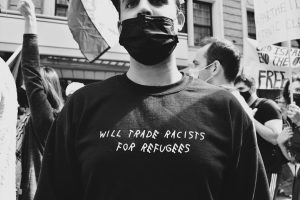
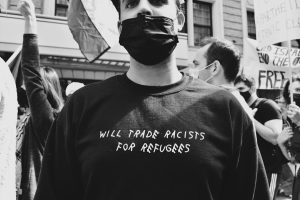
Photo by New York Said on Unsplash
Relacionado
Discover more from Fyra - Dating App for Progressives
Subscribe to get the latest posts sent to your email.