
I used to think of “being a good person” as a kind of fixed identity: you either were one or you weren’t. If I voted the right way, signed the right petitions, read the right books, I could rest in that identity and feel complete.
That illusion didn’t last.
Over the last few years—through conversations that left me uncomfortable, through mistakes I made loudly and publicly, through listening to people whose lives look nothing like mine—I’ve started to understand allyship and solidarity less as a label and more as a practice. Not a badge we wear, but a way we show up, especially when it’s inconvenient, humbling, or costly.
This is a reflection on that shift: how we move from “I’m one of the good ones” to “I’m learning, I’m accountable, and I’m in this for the long haul.”
—
The moment the mirror cracked
A few years ago, I was in a small group conversation after a workshop on racial justice. I’d spoken up several times, sharing articles I’d read and “insights” I’d gathered. At one point, a Black woman in the group gently said, “I’m curious—do you realize how much space you’re taking up right now?”
I felt my stomach drop. My first instinct was to defend myself: But I’m on your side. I’m trying to help. I’m not like those other people.
Underneath that defensiveness was something more fragile: the fear that maybe I wasn’t the person I believed myself to be.
Later that night, replaying the conversation, I realized something uncomfortable: I had been more focused on being seen as “aware” and “informed” than on actually listening. My allyship was performative in that moment. I had centered my voice and my need to be recognized.
That realization hurt—but it was also a turning point. It invited a different question:
Instead of “Am I a good ally?”
I began asking, “How am I showing up right now—and for whom?”
—
From identity to practice
When allyship becomes an identity, a few predictable things tend to happen:
– We resist feedback because it threatens who we think we are.
– We confuse intention with impact.
– We seek comfort, affirmation, and “credit” more than change.
– We show up when it’s public and praised, and disappear when it’s quiet, messy, or risky.
When allyship becomes a practice, it looks different:
– We expect to get things wrong—and stay anyway.
– We treat feedback as a gift, even when it stings.
– We measure ourselves less by what we say we believe and more by how our choices affect people with less power.
– We’re willing to be uncomfortable, to lose status, or to change deeply held beliefs.
This isn’t just about race, or gender, or sexuality, or disability—it’s about all the ways power and privilege shape our lives. It’s about intersectionality: the recognition that people are rarely oppressed or privileged in just one way, and that our movements for justice are deeply connected.
—
Privilege: not a guilt trip, but a responsibility
Privilege is one of those words that can shut people down before the conversation even starts. It can feel like an accusation: You didn’t suffer enough. Your pain doesn’t count.
But privilege isn’t a moral judgment; it’s a description of how systems treat us. It’s any unearned advantage we benefit from because of how we’re perceived—our race, gender, class, citizenship, ability, body size, language, and more.
I remember the first time I really felt the weight of my own privilege. I was walking home late at night, headphones in, absentmindedly scrolling my phone. A friend later told me, “I could never do that. It’s not safe for me in my body, in my neighborhood.”
I had never had to think about whether my mere presence in a space might be interpreted as a threat, or an invitation, or a target. That was a small moment, but it opened a door: If there are whole categories of fear and vigilance I never have to carry, what does that allow me to do? To risk? To ignore?
The point isn’t to drown in guilt; guilt is rarely transformative on its own. The point is to recognize that privilege gives us choices—and then to ask: What am I doing with those choices?
—
Questions for self-reflection
If you want to turn allyship into a living, breathing practice, it helps to start with honest questions. You might sit with these, journal about them, or discuss them with someone you trust:
1. Where do I hold privilege?
Think about race, gender identity, sexuality, class, ability, age, body size, language, citizenship, religion. Where do systems tend to treat you as “default” or “normal”?
2. Where do I experience marginalization?
How have you been dismissed, endangered, or excluded because of who you are? How does that shape your view of justice and safety?
3. When do I get defensive?
What topics or critiques make you feel attacked or misunderstood? What might that defensiveness be protecting?
4. Whose voices shape my understanding?
Are you mostly hearing from people who share your background? Whose stories are missing from your media, your bookshelf, your social circle, your workplace?
5. How do I respond when I’m called in or called out?
Do you shut down, argue, disappear, or lean in and learn?
These questions aren’t a test to pass; they’re a compass. They help us orient ourselves so we can move more intentionally.
—
Moving from awareness to action
Awareness is necessary, but it’s not enough. The world doesn’t change because we understand it better; it changes because we act differently within it.
Here are some concrete ways to embody allyship and solidarity in daily life:
1. Listen longer than feels comfortable
In conversations about harm or injustice, resist the urge to jump in with your story, your solution, or your explanation. Practice:
– “Tell me more about how that felt.”
– “What do you need from me right now?”
– “Is it okay if I ask questions, or would you rather I just listen?”
Listening is not passive. It’s an active choice to center someone else’s reality.
2. Believe people about their own experiences
You don’t have to fully understand someone’s experience to believe them. When a colleague says a comment was racist, sexist, or ableist, avoid reflexive responses like “I’m sure they didn’t mean it” or “Are you sure you’re not overreacting?”
Try instead:
– “I believe you.”
– “I’m sorry that happened.”
– “How can I support you?”
Believing people is a powerful form of solidarity.
3. Use your access strategically
Ask yourself:
– Where do I have access that others don’t? (Rooms, networks, decision-making spaces, social capital.)
– How can I use that access to open doors, redistribute resources, or challenge harmful norms?
Examples:
– In meetings, notice who is interrupted or ignored, and redirect attention: “I think [Name] was still speaking.”
– If you’re invited to speak on a panel and notice it lacks diversity, suggest additional speakers and make your participation conditional on broader representation.
– Share job postings, scholarships, or opportunities directly with people who are often excluded from those spaces—and advocate for inclusive criteria.
4. Take feedback as part of the work, not the end of it
You will make mistakes. You will say the wrong thing. You will miss something important. That doesn’t disqualify you; it humanizes you.
When someone calls you in or out:
– Pause. Breathe. Notice the urge to defend yourself.
– Thank them, if you have the capacity: “I appreciate you telling me.”
– Reflect: What can you learn here? What will you do differently next time?
– Repair if needed: a sincere apology, a changed behavior, a concrete action.
Accountability is not punishment; it’s an invitation to grow.
5. Let this change you, not just your opinions
It’s one thing to adopt new language; it’s another to let your worldview be rearranged.
That might mean:
– Reconsidering career choices or how you use your skills.
– Shifting how you spend money, time, and attention.
– Losing comfort in spaces that once felt easy because you now see the harm they normalize.
– Letting go of relationships or institutions that refuse to move toward justice.
Solidarity isn’t just about standing beside someone; it’s about allowing their struggle to reshape your priorities.
—
Building a better world, one relationship at a time
It’s tempting to think in grand scales: systemic change, policy reform, global movements. Those matter deeply. But systems are also sustained in the micro-moments of everyday life: in jokes we let slide or challenge, in hiring decisions, in classroom dynamics, in family conversations, in who feels safe walking down a street at night.
The work of building a better world happens at both levels at once:
– Inside us, as we unlearn, heal, and grow more honest about the power we hold and the harm we’ve participated in.
– Between us, as we practice showing up more consistently and courageously for one another.
– Around us, as we push institutions and systems to align with the values we claim to hold.
You don’t have to have it all figured out to begin. In fact, you can’t. The practice of allyship and solidarity is inherently unfinished. It’s a commitment to keep asking:
– Who is being left out or harmed here?
– What is my relationship to that harm?
– What can I do—alone and with others—to reduce it?
—
If there’s one thing I’ve learned, it’s this: being “one of the good ones” is a story that keeps us stuck. Being one of the growing ones—that’s where possibility lives.
We don’t need more perfect allies. We need more imperfect people willing to listen, to change, and to act—even when no one is watching, even when it costs us something, even when we’re afraid we’ll get it wrong.
The question isn’t “Am I a good ally?”
The question is: How will I show up today—and who will I stand beside as I do?
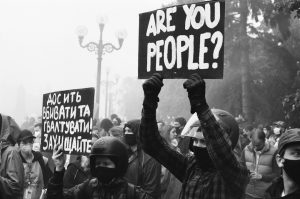
Photo by Hasan Almasi on Unsplash
Relacionado
Discover more from Fyra - Dating App for Progressives
Subscribe to get the latest posts sent to your email.