Love, Liberation, and the Long Arc of Racial Justice
Dating apps don’t usually market themselves as tools for social change. They’re for flirting, swiping, maybe finding “your person” or at least someone who loves the same weirdly specific podcasts you do. But beneath all the memes, emojis, and awkward first messages, dating is one of the most intimate ways we enact our values. Who we love—and how we love—has always been deeply political, especially when it comes to race.
Racial justice isn’t just about laws, policies, or headlines. It’s also about who gets seen as lovable, who gets stereotyped, who gets excluded, and who gets to feel safe and fully themselves in relationships. In a world shaped by systemic racism, our romantic lives don’t sit outside the struggle for justice—they’re right in the middle of it.
This is a reflection on how racial justice shows up in our dating lives, what’s changed, what hasn’t, and how we can move toward something more liberatory, more honest, and more loving—for everyone.
Love in the Shadow of History
To understand racial justice in dating today, we have to remember that for most of modern history, love across racial lines was not just frowned upon—it was criminalized and violently punished. Anti-miscegenation laws in the United States, for example, made interracial marriage illegal in many states until the late 20th century. People were jailed, assaulted, and even killed for loving someone the law said they shouldn’t.
These laws weren’t just about marriage certificates. They were about maintaining a racial hierarchy: deciding whose bodies “belonged” to whom, whose children were “acceptable,” whose communities would be allowed to exist. The state reached into people’s bedrooms and hearts and said: this kind of love is allowed; that kind is not.
Even after such laws were struck down, the social norms they enforced didn’t vanish overnight. Stereotypes about Black women being “too strong” or “too much,” Asian men being “less masculine,” Latina women being “spicy,” Indigenous people being “mystical,” or white partners being “prizes” didn’t emerge from nowhere. They were shaped by centuries of colonization, slavery, segregation, and media that cast some people as desirable and others as disposable.
We inherit all of that, even if we never asked to. Our preferences, our “types,” our fantasies, our fears—they don’t form in a vacuum. They’re shaped by what we’re taught to see as beautiful, respectable, or dangerous. That doesn’t mean our attractions are fake; it means they’re not neutral. And that’s where reflection becomes powerful.
Swipe Culture, Algorithms, and the Illusion of Neutrality
Today’s dating landscape is profoundly digital. Algorithms help decide who we see and who sees us. Profiles compress complex people into a handful of photos, prompts, and checkboxes. It’s easy to believe that all of this is neutral—that if someone doesn’t show up in our feed, it’s just “how the app works,” or if we keep matching with people who look like us, it’s just “our type.”
But technology is built by people, and people live in a racialized world. Studies and user stories have repeatedly shown that:
- People of color, especially Black women and Black men, often receive fewer matches and messages than white users.
- Asian men and Black women in particular report feeling “invisible” or hyper-visible in fetishizing ways.
- Filters by race or ethnicity reinforce exclusion and sometimes outright racism, cloaked as “preference.”
- Algorithms trained on existing behavior can amplify bias: if users disproportionately like certain racial groups, the system learns to show those groups more often and others less.
On top of that, there’s the everyday racism that can show up in messages and profiles: racial slurs, “no [insert race]” disclaimers, or “compliments” that are actually dehumanizing (“I’ve never been with a [insert group] before”). For many people of color, dating apps are not just spaces of possibility, but also spaces of repeated harm.
And yet, there’s another side to this story. Many interracial couples first met online. People use dating apps to connect across cultural, racial, and geographic boundaries they might never cross in their offline lives. Some apps are deliberately building tools and policies that challenge bias: removing race filters, banning hate speech and exclusionary language, and designing features that promote safety and equity.
The digital dating world is not inherently racist or inherently liberatory. It’s a reflection of us—and a set of systems we can reshape.
What Racial Justice in Dating Could Look Like
So what does it mean to move toward racial justice in our romantic lives? It’s bigger than “don’t be racist” and more nuanced than “just date whoever you want.” It’s about creating conditions where everyone can show up as fully human, fully complex, and fully worthy—without being punished or erased because of race.
On a personal level, that might look like:
- Interrogating “preferences.” When we say we’re “just not into” a certain race, where does that come from? Are we reacting to individual experiences, or to stereotypes we absorbed from media and culture? What happens if we sit with that discomfort instead of defending it?
- Rejecting fetishization. There’s a difference between appreciating someone’s cultural background and reducing them to it. If the appeal of a match is mostly about checking a box (“I’ve always wanted to try dating a [x]”), that’s a sign to slow down and reconsider.
- Practicing curiosity and humility. Racial justice in dating isn’t about being “perfect.” It’s about being willing to listen, to learn, to apologize when we harm someone, and to keep growing.
- Sharing power. In relationships that cross racial lines, it’s crucial to notice whose comfort is prioritized, whose culture is centered, whose fears get taken seriously. Love doesn’t erase power dynamics; it gives us a chance to transform them.
On a platform level, racial justice might mean:
- Designing against bias. Apps can audit their algorithms for racial disparities, adjust ranking systems that marginalize certain users, and avoid features that enable discrimination (like race filters).
- Clear, enforced policies. Zero tolerance for racial slurs, exclusionary language (“no Black people,” “no Asians”), and harassment—backed by real moderation and transparent consequences.
- Representation. Marketing, prompts, and in-app content that show diverse couples and individuals in nuanced, non-stereotypical ways helps reshape what users see as “normal” or “desirable.”
- Safety tools. Easy ways to block, report, and receive support after experiencing racism or harassment, especially for users who are already at higher risk of harm.
Racial justice in dating doesn’t mean forcing connections that aren’t there. It means removing the barriers that prevent people from being seen as fully human—and challenging the systems that perpetuate unequal access to love, care, and safety.
Hope, Healing, and the Work Ahead
There is real reason for hope. Younger generations are more likely than previous ones to date and marry across racial lines. Conversations about systemic racism, colorism, and representation have moved from the margins into mainstream discourse. Many people are actively unlearning harmful narratives and choosing partners—and friendships—more consciously.
There’s also a growing understanding that racial justice isn’t just about “inclusion” but about transformation. It’s not enough to invite people of color into spaces and systems that weren’t built for them. We have to redesign those spaces and systems—from dating apps to workplaces to governments—to reflect values of equity, care, and community.
At the same time, backlash is real. Racial justice movements face political attacks, misinformation campaigns, and attempts to roll back hard-won gains. Online spaces can amplify hate as easily as they amplify love. For many, the emotional labor of navigating racism in dating is exhausting and deeply painful.
Hope, in this context, isn’t naive optimism. It’s a commitment: to keep showing up, to keep telling the truth, to keep building relationships that reflect the world we’re fighting for. It’s recognizing that every time we choose empathy over defensiveness, accountability over denial, and connection over fear, we bend the arc a little more toward justice.
Where We Go From Here: A Call to Reflection and Action
Racial justice can feel abstract until we realize how intimately it touches our lives. It’s in who we swipe right on, who we message back, who we feel safe meeting in person, whose stories we believe, and whose we dismiss. It’s in the jokes we let slide, the “preferences” we never question, and the assumptions we make without even noticing.
If you’re reading this, you’re already in the conversation. The question is: what will you do with that?
Some starting points:
- Reflect on your patterns. Look back at the people you’ve dated, matched with, or messaged. Do you see patterns around race or ethnicity? What might be shaping them?
- Listen to voices of color. Seek out essays, podcasts, and creators who talk about dating and race. Believe their experiences, even if they’re different from your own.
- Challenge casual racism. When friends make “preferences” sound like facts, or when someone sends you a racist message about a match, speak up. Silence is its own kind of message.
- Support platforms that prioritize equity. Pay attention to how apps handle racism and bias. Choose to invest your time in spaces that align with your values.
- Practice care in every interaction. Behind every profile is a person with a history, a community, and a heart. Treat them like it.
Our romantic lives are not separate from our politics; they’re one of the most powerful places we can live our values. Racial justice isn’t only won in courts or streets—it’s also built in everyday choices, quiet conversations, and the relationships we nurture.
The next time you open a dating app, consider this an invitation: to look a little deeper, to love a little more courageously, and to ask yourself not just who you’re searching for, but what kind of world you’re helping create with every swipe.
Because love, at its best, isn’t colorblind. It’s clear-eyed, accountable, and committed to justice—for you, for your matches, and for all of us.
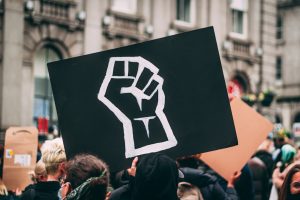
Photo by BP Miller on Unsplash
Stay Connected with Flamr
Don’t forget to follow Flamr on social media!
Relacionado
Discover more from Fyra - Dating App for Progressives
Subscribe to get the latest posts sent to your email.